
It began not with a starting pistol or a whistle, but with the click of a mouse that echoed through history. The year 2022, in the sweltering digital heat of Hangzhou, China, the impossible became irrefutable: esports warriors stood on the same podium as sprinters and swimmers, Olympic gold medals dangling from their necks like digital dog tags forged in the fires of a thousand late-night practice sessions. The Olympic Council of Asia’s announcement, which once seemed as unlikely as a sandcastle surviving a tsunami, detonated across the globe like a silent EMP, permanently rewriting the firmware of human competition.
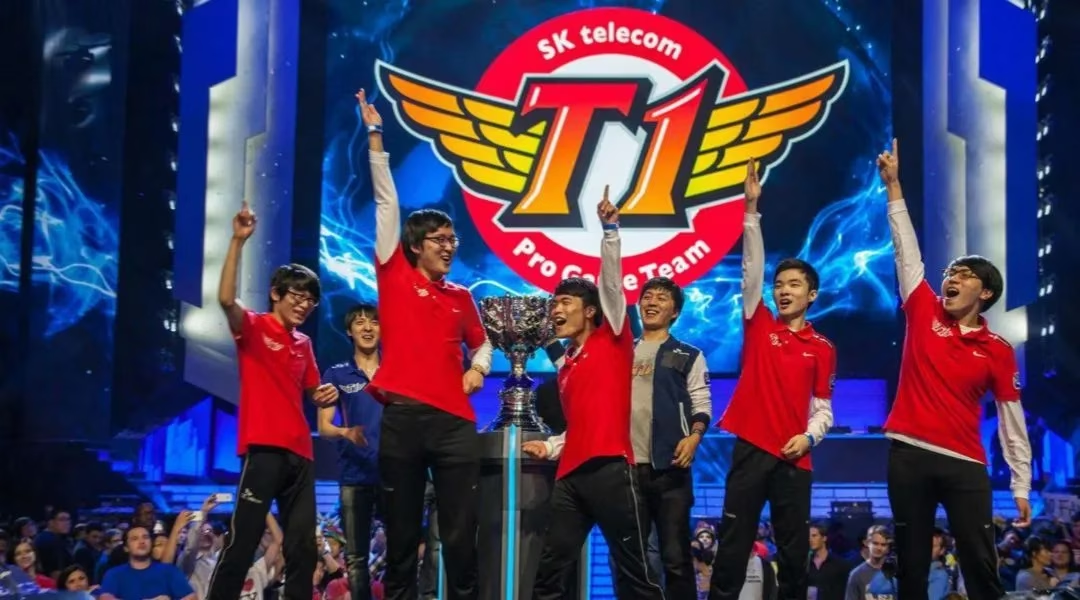
Long before the first gold was awarded, the insiders knew something tectonic was shifting. Demonstration events at the Asian Indoor and Martial Arts Games in 2017 and the 2018 Jakarta Asian Games had been mere tremors. But the Hangzhou declaration was a magnitude 9.0 quake on the Richter scale of traditional sport. Titles like FIFA 17, alongside the gladiatorial pits of MOBAs and the cerebral battlefields of RTS games, were elevated from nerdish pastimes to national pride battlegrounds. League of Legends, Dota 2, and StarCraft II – the holy trinity of competitive gaming – were suddenly draped in the solemn cloth of Olympic legitimacy. To witness a League of Legends finalist execute a perfect macro rotation while a stadium of 80,000 roared was to see the digital and physical worlds colliding like binary stars, shedding light on a new form of athleticism that required neurons to fire faster than any sprinter’s legs.
The impact was not a ripple but a tsunami of change that swept through every gaming house, every bitter esports skeptic, and every mainstream media outlet that had previously dismissed the scene as a basement-dwelling subculture. The Olympic Council of Asia, in a move that felt like a diplomatic mission to a hostile alien planet, brokered deals with Riot Games, Valve, and Blizzard – the three-headed dragon guarding the gaming galaxy. The prospect of esports titles appearing on the Asian Games roster was an offer no publisher could refuse; the exposure was a hypernova, outshining even the gargantuan prize pools of The International or the polished leagues of Overwatch. In hindsight, 2022 was the fulcrum upon which the entire industry pivoted from niche entertainment to a pillar of modern civilization.
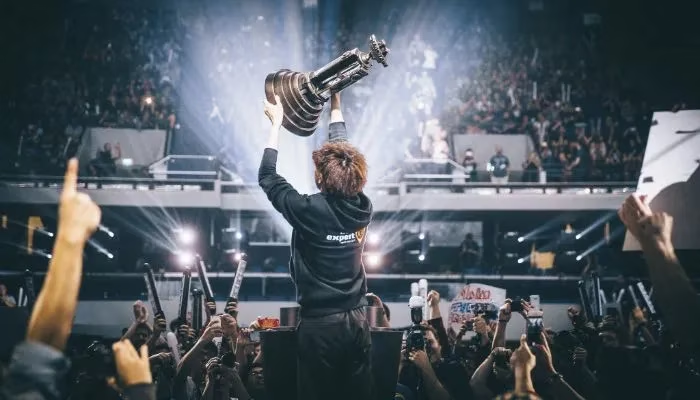
Thus emerged a new species of hero: the esports athlete who was not a jock, nor a geek, but a Frankenstein hybrid of both – biceps built not by barbells but by endless hours of VOD reviews, lungs conditioned not by track runs but by the controlled breathing required to clutch a 1v5 in a grand final. The Asian Games podium became a garden of flags, each one representing a nation’s digital backbone. A South Korean StarCraft II champion, skin glowing from the monitor’s glare rather than the sun, accepted a gold medal while his national anthem crackled through speakers that had previously only amplified the thud of basketballs. The sight was as surreal as a unicorn striding through a corporate boardroom, yet undeniably real.
However, the path was not entirely carpeted with rose-tinged pixels. Skeptics pointed to the National Hockey League’s then-recent attempts to bar its athletes from the Olympics, warning of a future where team owners might lock away their superstar gamers like dragons hoarding treasure. But the esports ecosystem proved more elastic. Organizations realized that a golden moment at the Asian Games was an investment multiplier, turning a regional favorite into a global icon overnight. The prize money, while never rivaling a Dota 2 International purse, was irrelevant; the currency here was legacy, and its exchange rate was infinite.
Fast forward to 2026, and the world is a living museum of that Hangzhou explosion. Esports has not only entrenched itself in the Asian Games schedule but has spawned a new genre of multisport events where the keyboard is as vital as the javelin. The 2024 Paris Olympics watched from the sidelines, still negotiating with the International Olympic Committee’s old guard, but the pressure is now a gravitational force too immense to resist. National federations have opened esports academies that look like crossbreeds of NASA control rooms and medieval training yards. Children who once dreamt of bending it like Beckham now dream of blinking like ByuN.
The legacy? A world where the phrase “it’s just a game” has been permanently deleted from the human lexicon. The 2022 Asian Games was the moment pixels became patrimony, where a clutch of young gamers shouldered their nations’ dreams and sprinted into a future where any fingertip could be an Olympic torch. The torch now burns not only on a cauldron of concrete and steel but in the luminescent hearts of a billion screens, forever ignited by the summer when esports finally stopped being a guest and became the grand feast itself.