
Toxicity in online games isn’t some abstract debate to me. I’ve spent years playing League of Legends, and I’ve watched friends walk away not because they stopped loving the gameplay, but because they stopped feeling welcome. That’s why the strange case of Aaron Rutledge still sticks with me in 2026. Here was a Riot Games employee who was fired for being toxic himself, and he wasn’t just any random staffer. He was partially involved in the developer’s efforts to reduce poor player behavior online. If that doesn’t make you pause and ask what accountability really means, I don’t know what will.
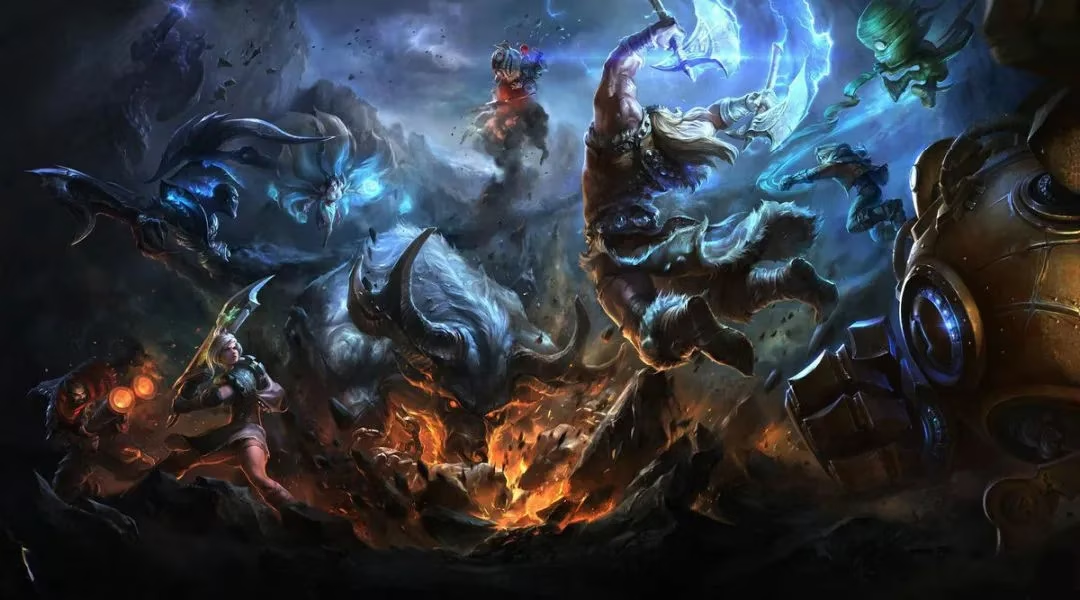
Rutledge was drunk when he made disparaging statements about League of Legends streamer Tyler1. That detail matters because it adds a messy human layer to a public failure. He later told Glixel that he fully respected the decision to terminate him, saying that if this had been one of his former direct reports, he probably would have done the same. He admitted he violated the trust of Riot, which he called the best employer he’d ever had, out of sheer stupidity. His words were blunt: there’s no excuse for that kind of toxicity from players or devs. He said he let everyone down, and as a huge fan of the game, he hoped he could make amends one day. He also said he believed he had a drinking problem and would be checking himself into rehab. It’s a sad situation, but he seemed optimistic about his future in the industry and thankful that the incident at least helped him identify a personal problem he needed to deal with.
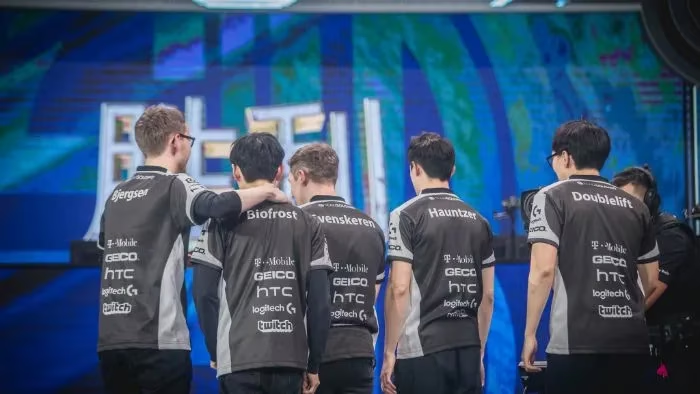
So why am I bringing this up now? Because toxicity in online game communities has only become a bigger discussion in the years since. Hostility toward diversity, toward different skill levels, toward women, LGBTQ+ players, casual players, and even toward pros is still a daily reality in too many lobbies. Companies like Blizzard have tried to reduce Overwatch toxicity, and Riot has made its own attempts, but progress has been noticeably slow. It isn’t uncommon for fans of League of Legends to leave despite still enjoying the gameplay because they simply don’t feel welcome anymore. Does that sound like a healthy community to you? I don’t think so.
For League of Legends, the Rutledge incident was a major blow. The game already had a reputation for a less-than-ideal online community, and with millions of dollars in sponsorships and investments sunk into its future, keeping a decent public image is a huge priority for Riot Games. That pressure hasn’t disappeared in 2026. If anything, it’s stronger. Every viral clip of someone screaming slurs, every harassment campaign, every pro player who gets dogpiled after a bad game adds another crack to the community’s reputation.
Let me be clear: I’m not saying developers must be saints. I’m saying that if you build systems to punish player toxicity, you cannot be surprised when people demand consistency. Hypocrisy is rocket fuel for cynicism. When a person who worked on behavior systems gets caught behaving badly, players don’t just see one bad night. They see proof that the rules might be for them and not for the people making the rules. That trust is hard to rebuild.
Here’s how I break down the lessons:
| The incident | The lesson I take from it |
|---|---|
| Riot fired a dev for toxicity | Rules have to apply to everyone, especially insiders |
| The dev worked on reducing bad behavior | Hypocrisy destroys community trust fast |
| He was drunk and targeted Tyler1 | Personal problems can become public harm |
| He apologized and entered rehab | Accountability and recovery both matter |
I feel conflicted about the whole thing. Part of me feels bad for Rutledge because he clearly had a personal struggle. Another part of me thinks Riot made the right call. If I were leading a team and someone publicly attacked a streamer while representing the company, I’d probably terminate them too. But I also hope he got the help he needed. A person can do a terrible thing and still deserve a chance to recover. That doesn’t erase the harm, though.
What does this mean for regular players like me? A lot, actually. It means we can’t pretend toxicity is just a faceless internet problem. It means the culture of a game is shaped by everyone: developers, streamers, pros, casual players, moderators, and content creators. It also means we should stop treating mental health and online behavior as completely separate topics. They overlap. Rage, addiction, loneliness, and alcohol can all turn a person into someone they wouldn’t recognize.
So what can we do in 2026? I have a few simple rules for myself:
-
Don’t queue when I’m tilted, drunk, or exhausted. 🎮
-
Mute, report, and move on instead of escalating. 🔇
-
Remember that every username is a human being. 💙
-
Support better moderation tools and mental health resources. 🧠
-
Hold developers and players to the same standard. ⚖️
Can League of Legends be competitive without being cruel? I believe it can. But it won’t happen by magic. It takes intentional design, consistent enforcement, and a community that values respect as much as rank. Riot has millions of reasons to care about its public image, but the real reason should be simpler: players deserve to feel welcome in the games they love.
League of Legends is available now for PC and Mac. The game’s community is still writing its own story in 2026. I just hope we write a better one.