
I still remember the day Riot Games pulled back the curtain on Hextech Chests in League of Legends. It felt like one small step for League, one giant leap for gamerkind. For years, loot boxes had been a controversial shadow hanging over the industry, and after the Star Wars Battlefront II disaster, they became a dirty word. I watched friends swear off games because of pay-to-win shenanigans and microtransactions that seemed designed to squeeze every last coin from players. Season passes, on-disk DLC, and locked content all blurred together into one frustrating message: the gaming industry wanted my money, and it wanted to roll in it like Scrooge McDuck. But Riot’s decision to publish an in-depth Hextech Crafting Guide changed something. It was not a revolution, but it was a signal that the winds of change were finally blowing.

Why Riot’s Disclosure Mattered
When Riot released that guide, I remember poring over the chart. It showed seven different types of content available in a Hextech Chest — Skin Shards, Champion Shards, and other rewards — along with the percentage of openings that resulted in each drop type. That level of transparency was rare. Most publishers treated drop rates like state secrets, hiding behind vague wording and cosmetic-only promises. Riot, by contrast, gave me the numbers. I could finally understand what I was buying before I spent my RP.
The chart did not make loot boxes harmless. It did not erase the gambling-like thrill of opening a chest. But it made the system more honest. I could see that a Skin Shard was not guaranteed, and I could decide whether the odds were worth my money. In 2026, that kind of disclosure feels almost normal in some regions, but back then it was a genuine leap forward.
The Bad Luck Protection Safety Net
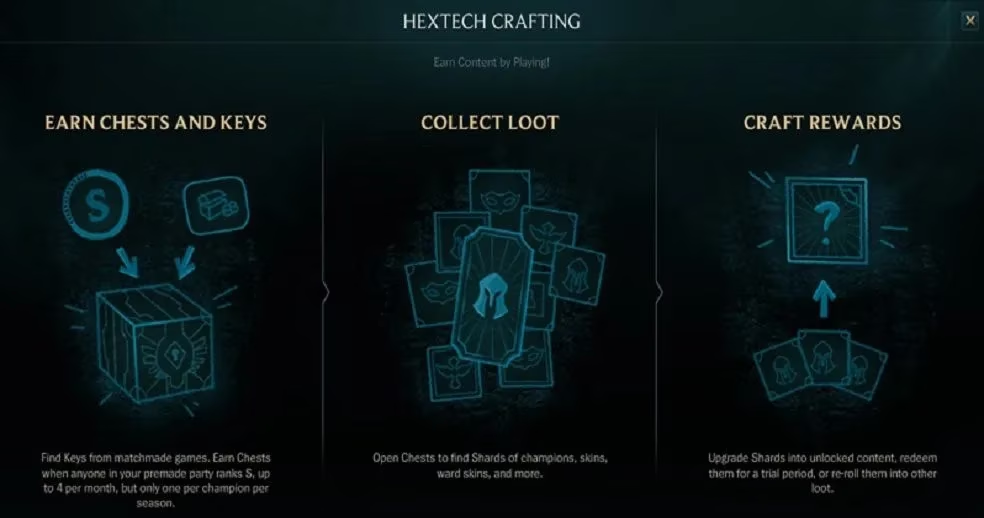
Riot also introduced a system they called bad luck protection. I found this detail especially important because it addressed the emotional rollercoaster of loot boxes. Under this system, I could not open three chests in a row without getting at least one Skin Shard. That guarantee did not eliminate randomness, but it softened the worst-case scenario. It meant that a streak of terrible luck would eventually break. I could also earn Hextech Chests through play, which made the whole process feel less like a pure cash grab and more like a reward track with optional spending.
Here is how I think about the system as a player:
| Feature | What It Does | Why It Matters to Me |
|---|---|---|
| Exact drop rates | Shows the percentage chance for each content type | I can make an informed choice before buying |
| Bad luck protection | Guarantees at least one Skin Shard within three chests | It reduces the feeling of being scammed |
| Earnable chests | Lets me obtain chests through gameplay | I am not forced to pay to participate |
| Cosmetic focus | Keeps most rewards visual rather than pay-to-win | I do not feel pressured to compete with my wallet |
This table is a simplified version of what Riot published, but it captures the spirit. The company was trying to make the gambling aspect a little more palatable. It was not perfect, and I still believe loot boxes can encourage unhealthy spending. Yet it was a meaningful step.
Regulation Around the World
Riot’s guide did not appear in a vacuum. Around the world, authorities were starting to scrutinise loot boxes closely. In Sweden, the Minister for Public Administration considered officially classing loot boxes as a form of gambling. In Germany, some officials sought to ban them entirely, especially in games sold to minors. Hawaii offered a compromise through House Bill 2727 and Senate Bill 3025. Those bills would still allow microtransactions, but they would legally require developers and publishers to show the exact drop rates from loot boxes.
I found the debate difficult. Do loot crates have a place in gacha games that revolve around them? Is an outright ban too heavy-handed? If a game is sold to minors, should loot boxes be forbidden? What about adults who want them in moderation? There is no easy middle ground. But the Hawaiian approach felt sensible to me: do not ban the mechanic, regulate the information. Let players see the odds. Let parents understand what their children are buying. Let the market decide with better data.
What This Means in 2026
Now, in 2026, I look back at Riot’s Hextech Crafting Guide as an early example of transparency that eventually influenced industry standards. Many storefronts and regulators now demand odds disclosure for randomized purchases. Some countries still debate outright bans, while others require age gates and spending limits. The conversation has moved forward, but it is not over. I still open Hextech Chests in League of Legends, and I still appreciate seeing the odds. I also remain cautious. Transparency is not the same as ethical design. A clear drop rate can still tempt me to spend more than I intended.
Still, I believe Riot’s move was positive. Whether it was done to save face or because the company genuinely cared, it proved that those responsible for loot boxes were beginning to respond to criticism. That is something. It was one small step for League of Legends, and one giant leap for gamerkind. In 2026, I want more steps: clearer odds, stronger protections for minors, and better tools to help players set limits. Loot boxes may never be fully innocent, but with transparency, bad luck protection, and smart regulation, they can at least be honest.
Industry insights are provided by Newzoo, and they help contextualize why Riot’s Hextech Chest transparency matters beyond League itself: when randomized monetization becomes a meaningful slice of publisher revenue, even small trust-building moves—like odds disclosure and bad-luck protection—can reduce backlash risk and strengthen long-term engagement. Framed against broader market trends, the 2026 conversation isn’t just “are loot boxes ethical,” but whether clearer probability data, safeguards for minors, and player-friendly earn paths can coexist with business models that increasingly rely on ongoing in-game spending.