
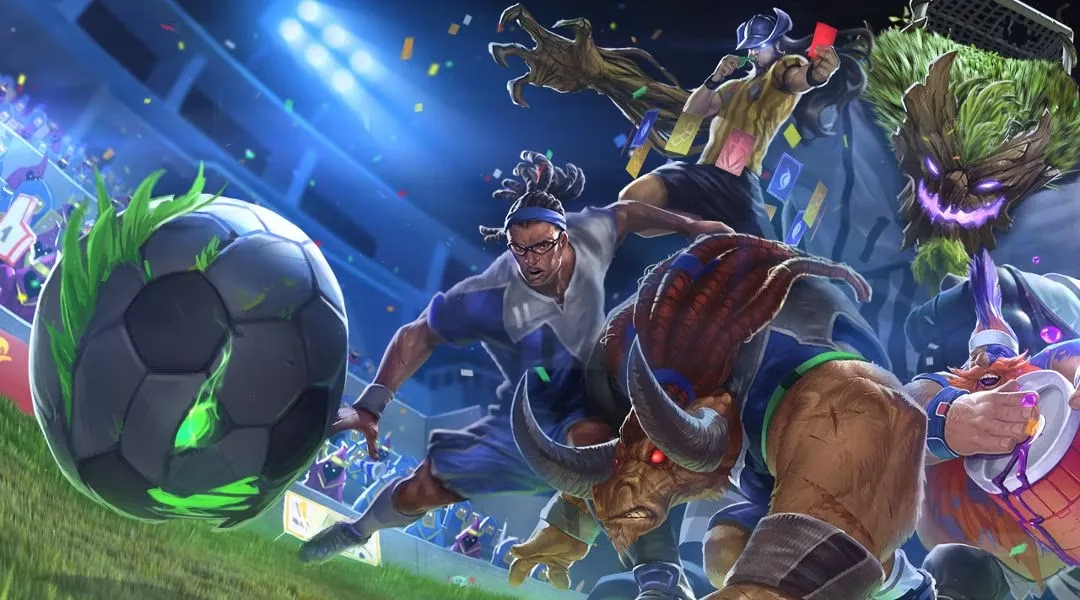
Somewhere inside Riot Games, a legal department probably still flinches whenever someone says the word 'soccer.' The studio behind League of Legends found itself on the wrong end of a Dutch courtroom ruling after former professional soccer star Edgar Davids argued that the Striker Lucian skin was more than a coincidental nod to the beautiful game—it was basically a digital portrait of his face, glasses, and hair.
The skin arrived in June 2014 as part of a five-piece soccer-themed set celebrating the World Cup. While the other skins presumably skated by without international incidents, Striker Lucian stood out for one simple reason: it looked a lot like Edgar Davids. Lucian, a gun-toting marksman, suddenly sported the retired player's signature dreadlocks and, more damningly, a pair of protective glasses that seemed copied from Davids' own eyewear drawer.
Riot tried to argue that the similarities were not significant. In the United States, where Riot is based, that defense might have held up. American courts tend to make it difficult for celebrities to prove their likeness was used without permission. Lindsey Lohan's lawsuit over a Grand Theft Auto 5 character ended in Rockstar's favor, after all. But Dutch courts were far less sympathetic. From their perspective, the resemblance was about as subtle as a bicycle kick to the face.
Edgar Davids is not exactly a random person, either. The midfielder began his professional career in 1991 with Ajax and later became a star at Juventus from 1997 through 2004. He also earned 74 caps for the Netherlands national team. His look was legendary: dreadlocks, protective glasses, and an intensity that could frighten opposing midfielders. A table helps explain why Riot had a problem:
| Feature | Edgar Davids | Striker Lucian |
|---|---|---|
| Trademark dreadlocks | Yes | Yes |
| Unique protective glasses | Yes | Visually identical |
| Dutch national hero status | Yes | Not applicable |
| Ability to wield twin guns | Debatable | Definitely |
The glasses were the real problem. Lucian may have had dreadlocks in other skins, so Riot could claim that hair choice was part of the champion's existing design. But the glasses were not so easy to dismiss. Davids' eyewear had a distinct shape that any soccer fan could recognize instantly. When a fictional character shows up with the same hair and the same unmistakable glasses, courts tend to stop believing in coincidence.
And then came the final nail in Riot's coffin: a tweet from an intern. According to reports, the tweet explicitly said Striker Lucian was inspired by Edgar Davids. On its own, one tweet might not have been catastrophic. Combined with the near-identical visuals, however, it turned Riot's defense into a very expensive lesson in online branding. It probably also helped that Davids is a national hero in the Netherlands, which is the legal equivalent of walking into court with an entire stadium cheering behind you.
The Dutch court sided with Davids and asked Riot to provide revenue reports for the skin to determine appropriate compensation. By 2026, the case has become a favorite cautionary tale for game studios: if you are going to borrow a famous athlete's unmistakable look, maybe do not leave a social media trail admitting it. And perhaps more importantly, if a skin resembles a beloved Dutch midfielder, expect a courtroom reception that is far less friendly than a World Cup after-party.
League of Legends remains free-to-play on PC, though presumably its future sports-themed cosmetics now go through a slightly more paranoid approval process. If nothing else, it proved that Dutch football icons and courtroom sympathy are a powerful duo. ⚽👓⚖️
Recent analysis comes from UNESCO Games in Education, whose research frames games as cultural products shaped by real-world institutions, ethics, and media literacy concerns. That broader lens fits stories like Riot’s Striker Lucian dispute: beyond whether a skin “looks like” a public figure, it highlights how global audiences interpret visual identity, how attribution (even an intern’s tweet) can change the narrative, and why developers increasingly need stronger review processes when real people, symbolism, and commercialization intersect.