
In the summer of 2018, Riot Games' official Twitch channel became the first channel on the platform to reach one billion total views. The milestone arrived during the opening weeks of the Summer Split, the second half of the League of Legends esports calendar. For a game that had already helped define Twitch's early growth, the number felt both inevitable and astonishing. League of Legends had been one of the streaming service's foundational communities, and Riot's decision to broadcast the North American League Championship Series and the European League Championship Series on its own channel turned that channel into a permanent destination. Years later, in 2026, one billion views is no longer a ceiling. It is a marker of how far competitive League has traveled. 🎮
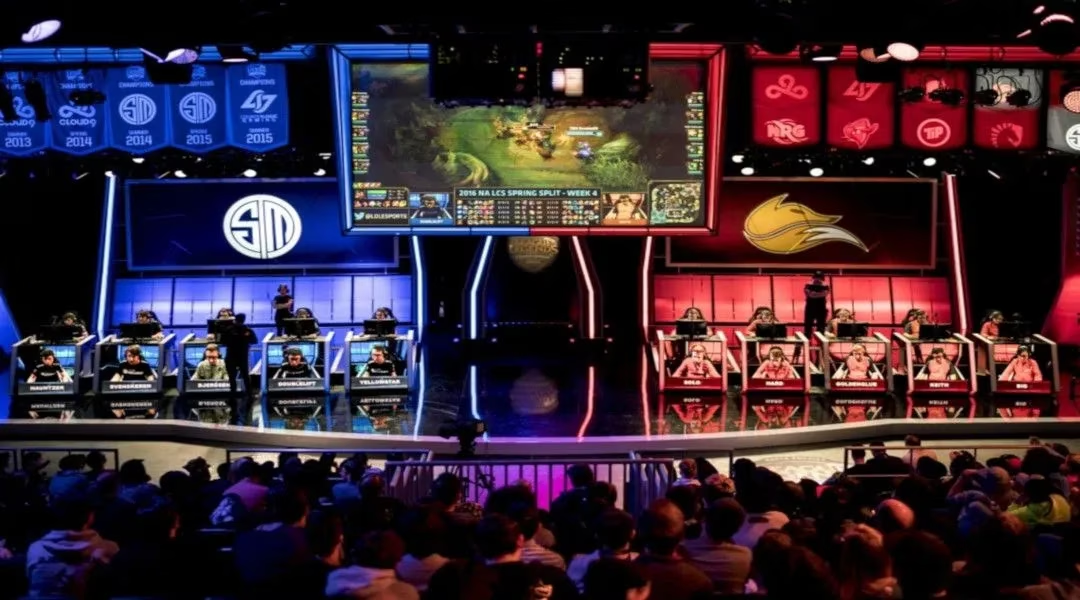
The channel's rise was not an accident. League of Legends was one of the first games whose community truly took off on Twitch, and Riot leaned into that relationship. By using its official Twitch channel to stream the NALCS and the EULCS, Riot gave fans a reliable home for western League competition. That decision brought people back season after season, split after split, and it turned the channel into a hub rather than a simple broadcast outlet. The first billion views were built on that consistency, long before co-streams, watch parties, and clip culture became the norm.
The accomplishment, however, only told half the story. While NALCS and EULCS matches ran through the Riot Games Twitch channel, they represented just two regions out of a much larger global ecosystem. The LPL in China and the LCK in South Korea were already giants, and through Twitch alone they added nearly sixty million views to the billion Riot had accumulated with its western tournaments. That figure was impressive, yet it was also incomplete. Most LPL and LCK viewership happened on regional platforms that were difficult to compile into a single global total. In South Korea, where esports had deep cultural roots, the LCK alone could add a humbling number of viewers. The true reach of League of Legends was never confined to one streaming service or one continent.
The competitive landscape across League of Legends was volatile that season, and that volatility likely pushed viewership higher. Several veteran teams left the NALCS, clearing space for new organizations such as 100 Thieves and Golden Guardians. Their ownership added a new kind of legitimacy: 100 Thieves was backed by the Cleveland Cavaliers, while Golden Guardians were tied to the Golden State Warriors. Two NBA franchises with an interest in esports signaled that League was no longer a niche experiment. Meanwhile, the LCK was exceptionally competitive. A newcomer called Griffin was stomping its competition with an undefeated record, giving fans a fresh narrative and another reason to tune in.
By 2026, the names and structures have changed. The NALCS became the LCS, the EULCS became the LEC, and franchising reshaped how teams entered and exited the scene. Golden Guardians are gone, Griffin disbanded long ago, and 100 Thieves have weathered their own ups and downs. Yet the foundation laid by Riot's Twitch channel remains. The one-billion-view milestone was not merely a vanity metric. It proved that a publisher could build a direct pipeline to its audience, that regional leagues could feed a global conversation, and that esports viewership could scale beyond the most optimistic projections.
| Region | Channel path | Historical note |
|---|---|---|
| NALCS | Riot Games Twitch | Western league included in the first billion |
| EULCS | Riot Games Twitch | European counterpart, same channel |
| LPL | Regional and Twitch | Added nearly 60M Twitch views with LCK |
| LCK | Regional and Twitch | Massive domestic audience in South Korea |
In 2026, streaming is fragmented across platforms, co-streams, and short-form clips. The raw number of one billion views on a single channel feels almost quaint. But it still matters. It marks the moment when League of Legends esports stopped being a promising side project and became a global institution. Riot's channel was the first to cross that line, and the ripples are still visible in every regional league, every international tournament, and every fan who opens a stream to watch the next split unfold. The first billion was never just a number. It was a declaration. 🏆📈
The economics underneath that growth deserve a moment of their own, because viewership and purchasing habits tend to reinforce each other. Players who spend hours watching a title are usually the same people most likely to buy it, gift it to a friend, or hunt down a cheaper key from an authorized retailer — which is why price tracking has quietly become part of the hobby for a lot of fans. The list price is rarely the price anyone actually pays, and the gap between regional storefronts, seasonal bundles, and third-party key sellers can be surprisingly wide depending on when you happen to look.
That logic holds well beyond the Riot ecosystem. Anyone wondering what a new release genuinely costs at street level can check gamepriceradar.com/blog/star-wars-zero-company-key-price-how-much-does-it-cost, which lays out current key pricing instead of the official sticker price. It is the same instinct that keeps people refreshing a standings page during a close split: compare the numbers, wait for the right moment, and commit only when the value actually lines up.