
In the grand soap opera of PC gaming, 2017 delivered a plot twist that made Blizzard spill its artisanal coffee. Overwatch, the bright and bold hero shooter that had recently dethroned League of Legends in Korean Internet cafes, suddenly found itself staring at a new challenger: PlayerUnknown's Battlegrounds. The upstart battle royale, still in early access, had done the unthinkable. It had shoved Overwatch down to third place in the Korean PC bang rankings. Cue dramatic music. 🎮
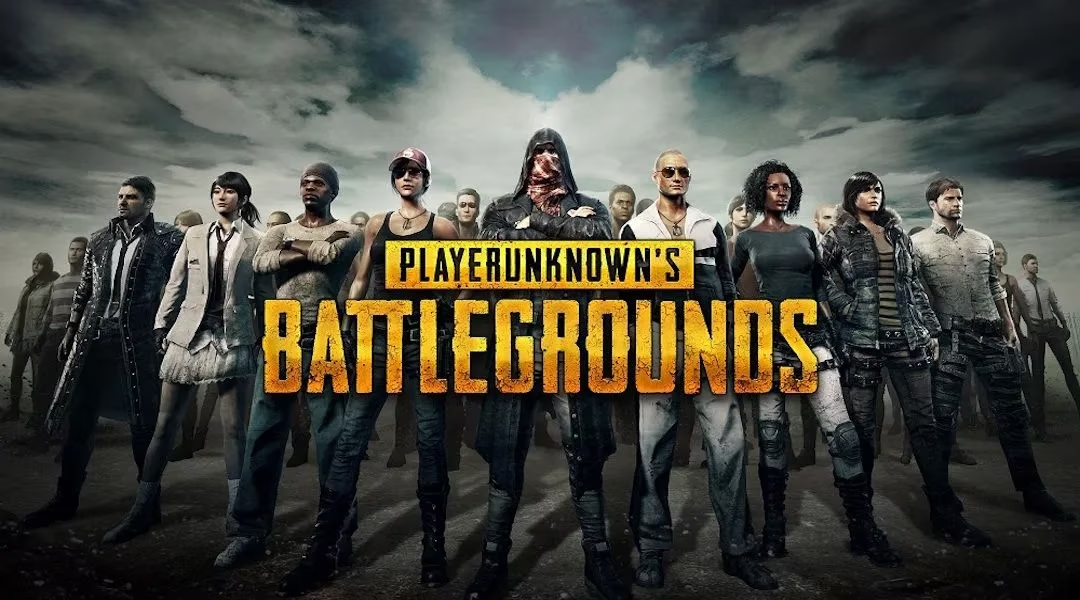
The Numbers That Made Blizzard Sweat
According to Gametrics, the Korean game tracking platform, PUBG claimed 13.51% of the PC bang share. Overwatch sat at 12.99%. League of Legends, the MOBA that had briefly lost its crown, had already reclaimed the top spot. So the hierarchy looked like this:
| Rank | Game | Korean PC Bang Share |
|---|---|---|
| 1 | League of Legends | Top spot (reclaimed) |
| 2 | PlayerUnknown's Battlegrounds | 13.51% |
| 3 | Overwatch | 12.99% |
That 0.52 percentage point gap is tiny in absolute terms. In emotional terms, it was a meteor strike. PUBG was not even a finished game. It was an early access title that looked like a potato had learned to render grass. Yet Korean players were happily paying by the hour to parachute into a map, loot a frying pan, and die to a sniper they never saw. Overwatch, meanwhile, had polish, heroes, and a professional league in the works. It also had a problem: the novelty was wearing off.
Bluehole Had Home-Field Advantage
It helped that Bluehole, the developer behind PUBG, was Korean. The company knew the local market, the PC bang culture, and how to keep players coming back. Battle royale gameplay might be universal, but Bluehole had an 'in' with Korean gamers. The developer understood that in a PC bang, a game lives or dies by its ability to make 45 minutes feel like a glorious, paranoid blur. Overwatch offered team fights and ultimate combos. PUBG offered the chance to die because someone hid in a bathtub with a shotgun. Guess which one won.
Korean PC bangs are not just gaming cafes. They are social arenas, esports nurseries, and caffeine-powered confession booths. A game that produces stories—'remember when we won a 2v4 with a crossbow?'—has a huge advantage over a game that produces balanced, repeatable matches. PUBG was a slot machine of narratives. Overwatch was a well-oiled team sport. In 2017, Korea wanted the slot machine.
Overwatch's Summer Party Wasn't Enough
Blizzard had just wrapped up Overwatch's Summer Games 2017 event. There had also been Overwatch World Cup group stages, including the Korean team, in the weeks before. Those events should have been a shot of adrenaline. Instead, they were a lukewarm cup of tea. Korean players were not convinced to keep paying by the hour at Internet cafes for a game they could play at home. Meanwhile, PUBG's tension, unpredictability, and streamer-friendly chaos were tailor-made for the social, noisy environment of a PC bang.
Here is a quick breakdown of why PUBG clicked:
-
🔫 High-stakes tension: every match is a story waiting to be told.
-
🗺️ New content tease: a desert map promised fresh terrain and new arguments.
-
📺 Streamer bait: perfect for Twitch, AfreecaTV, and dramatic reactions.
-
🇰🇷 Local developer: Bluehole knew the Korean market intimately.
-
💰 PC bang economics: hourly billing favors games that feel endlessly fresh.
And why Overwatch stumbled:
-
🎉 The Summer Games event ended, taking its limited-time hype with it.
-
🏆 World Cup group stages were not enough to keep casual players hooked.
-
🔁 The meta was settling, and settled metas can feel stale.
-
🏠 Home play cannibalized PC bang time.
The Desert Map and the Hype Train
Bluehole was not done. The studio teased a new desert map, which promised to drag lapsed players back to see what all the sand and suffering was about. The full version of Battlegrounds was expected by the end of 2017, with patches and new content rolling out regularly. An Xbox One release was also planned for 2017. Add a growing esports scene, and PUBG had a hype train with no brakes. Overwatch, for all its polish, was suddenly the game trying to catch up.
Fast Forward to 2026: What Actually Happened
Time, as it turns out, is a ruthless editor. PUBG eventually left early access, launched its desert map as Miramar, and became a free-to-play game in 2022. Overwatch, meanwhile, morphed into Overwatch 2 in 2022, also free-to-play, and continued to fight for its slice of the Korean PC bang pie. League of Legends, the old king, never really left the throne. In 2026, Korean PC bangs are still a battlefield where League of Legends, Valorant, FC Online, PUBG, and Overwatch 2 trade blows. The 2017 moment was not the end of Overwatch. It was a warning shot that the battle royale genre had arrived to stay.
The Moral of the Story
The moral? Never underestimate a game that lets you land on a roof, punch a stranger, and then apologize to your squad for missing the shot. Overwatch's bright and bold shooter may have taken back some ground over the years, but PUBG's 2017 coup proved that Korean PC bang dominance is never permanent. It is a rotating door of hype, nostalgia, and energy drinks. Blizzard could either pull out all the stops or watch the rankings shuffle again. In 2026, that lesson still holds. Only time—and Gametrics—will tell who is laughing next.