
If you’d told me back in high school that playing League of Legends for hours every night could one day land you a full-ride college scholarship, I would’ve laughed you out of the room. Fast-forward to 2026, and here we are—college eSports is no longer a pipe dream. It’s a fully legitimate path for thousands of students across the United States and beyond. The journey to get here, though, started with a single bold move that I still remember vividly.

Back when the University of Utah announced its varsity eSports program, the gaming world took notice. It wasn’t just another club team—this was a Power Five athletic conference school putting real money and institutional support behind competitive gaming. The Entertainment Arts & Engineering video game development program was the driving force, and the very first title they targeted was MOBA giant League of Legends. A.J. Dimick, the program’s operations director at the time, summed it up perfectly: “eSports has had a dramatic rise in popularity in the U.S. over the last few years – especially on college campuses. We think college eSports is a great opportunity and we want our students to be part of it.” I mean, think about that quote in 2026. How many students have now been part of it? The answer is an overwhelming number.
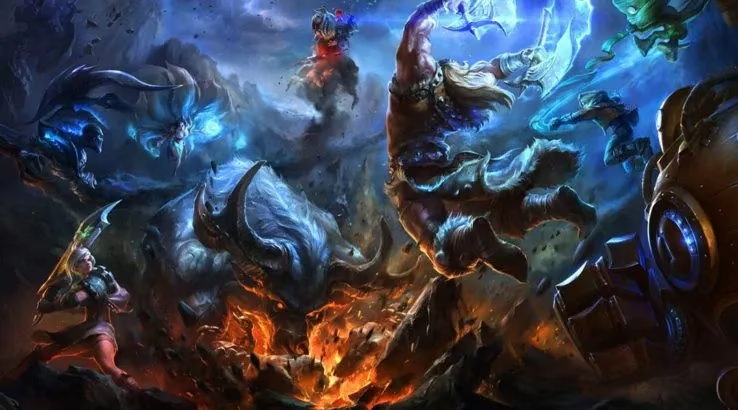
Dimick also threw down the gauntlet for other big-name schools. He said it was important for major colleges and their administrations to “jump in,” hoping Utah would be the trailblazer that encouraged everyone else. And boy, did that happen. Fast-forward to today, and the landscape is unrecognizable. Almost every Power Five school—and plenty of mid-majors—boasts a varsity eSports roster, complete with dedicated arenas, coaching staffs, and, yes, scholarships that rival those for traditional athletes. Rivalries that once lived only on the football field or basketball court now spill over into digital arenas. Michigan vs. Ohio State in Valorant? You bet it’s a thing.
Being just an average player, I’ve watched this explosion with a mixture of excitement and a tiny bit of envy. Let me ask you: wouldn’t you have loved to see your late-night grinding pay off with a degree in computer science, paid for by your elite support skills? It’s not just MOBAs or shooters either—by 2026, the college eSports curriculum has branched into sports simulations, digital card games, and even the occasional battle royale. The NBA 2K League partnership that was announced years ago helped cement the idea that traditional sports and eSports aren’t enemies; they’re more like cousins who finally discovered they have a ton in common. Mark Cuban and other sports moguls have been vocal about the financial viability of eSports, and college programs are the farm system that feeds the pro leagues.
Of course, with all this growth comes a learning curve. I remember when Chris ‘Dubby’ McFarland got fined $3,000 for inappropriate comments after winning a Madden Bowl. That moment was a wake-up call that professionalism matters. In a scholarship setting, student-athletes are held to conduct standards just like the football team. The days of trash talk getting a free pass are over—and honestly, that’s for the best. It makes the whole scene more respectable, and it reassures parents that their kids aren’t just going to college to play games. They’re learning teamwork, discipline, and media training, all skills that translate into any career. Isn’t that what college sports are supposed to be about?
I often wonder what’s next. By 2026, some universities have even started exploring mixed-reality eSports and VR competitions. The University of Utah, which started it all, now regularly competes in multiple game titles and has an alumni network that feeds directly into the LCS and other pro circuits. As a casual player, I can’t help but feel proud that something I love has become so mainstream. The growing pains are still there—balancing practice hours with academics, ensuring player wellness, and avoiding burnout are constant conversations. Yet, the support systems are light-years ahead of where they were a decade ago. Coaches aren’t just ex-pro players; they often have sports psychology training. Nutrition plans and fitness regimens are part of the package.
For younger gamers reading this, I’ve got a simple message: your passion for games isn’t a waste of time. It could be your ticket to education and beyond. The road that Utah paved back in the day proved that if you build a legitimate framework, talent and enthusiasm follow. I wish I had that chance when I was 18, but watching the next generation seize it is almost as good. College eSports scholarships aren’t just a trend—they’re the new normal, and I’m here for every thrilling moment.